


Skip Navigation LinksNews & Information > Sweepstakes Law Blog


Sweepstakes Law Blog


  • (By accessing, browsing or using the pages below, you agree to the Blog
    Conditions of Use/Disclaimer available under "Links.")
  • Sweepstakes nightmares: Your prize provider drops out

    A staffer at our law firm is not feeling amused by a certain amusement park. She recently won a sweepstakes for a fully-paid trip for four to this park. But now two weeks out from the trip, she and her family have no plane tickets, no room key and a growing animosity for the company.

    The amusement park is providing the prize, but it’s an L.A. broadcast company that sponsored the sweepstakes. And it’s that company that will be in the lurch if this woman’s trip falls through and she takes her grievances to Twitter.

    This PR nightmare could unfold for ...

    Full story

  • The IRS wins every sweepstakes

    Aside from the winners, there’s no one more excited about sweepstakes prizes than the IRS. States that collect income taxes get pretty tickled, too.

    Many sweepstakes winners don’t realize they have partners when it comes to accepting their prize. The IRS and state treasurers don’t care who wins the prize because they are guaranteed to receive a share of virtually every prize awarded. (They may, however, root for a winner in the highest tax bracket.)

    Thompson Coburn’s tax gurus can speak to this more specifically, but here are some basic facts about state and federal tax laws that sweepstakes creators ...

    Full story

  • Are you violating the Facebook contest rules?

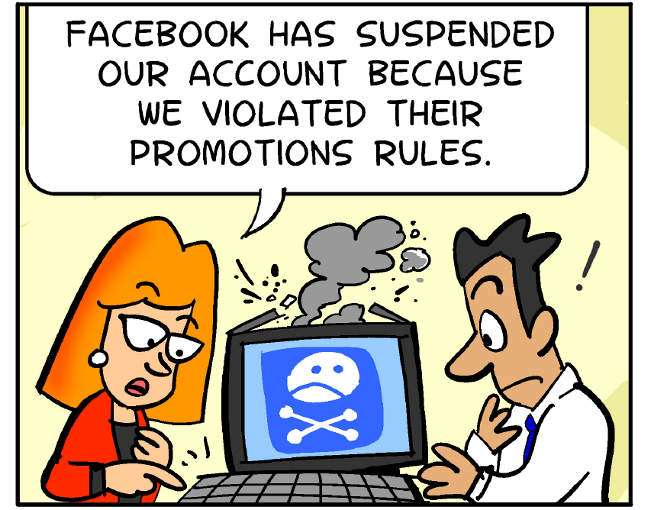
    “Like” it, “poke” it, but don’t post your latest sweepstakes on Facebook without some serious thought.  Your contest could be violating the site’s promotions rules.

    It’s unclear how closely Facebook is monitoring illegal sweepstakes, although the company has come down hard on a few mostly foreign companies.  Still, the threat of enforcement looms for any business that tries improperly to boost its brand among Facebook fanatics. 

    Facebook is now flooded with ads and promotions, in part because companies smartly realize the collective spending power of the 800 million users who log on to the site every month. The social networking giant ...

    Full story

  • Get your eyes on the prize: Tummy tucks but no tobacco

    Over the past 17 years, I’ve created hundreds of sweepstakes and contests. Thanks to my clients’ marketing savvy, these promotions have featured all kinds of prizes, including $100,000 college scholarships, new cars, boats, exotic vacations, backstage passes, celebrity meet-and-greets, fashion makeovers, clothes, jewelry, shoes, and simple bragging rights.

    It seems at times that virtually anything can be used a sweepstakes or contest prize, including one of my favorites, a facial makeover that included plastic surgery services. But while a sweepstakes could gift you with a skin-tightening facelift, it can’t offer the drugs that ease the pain of going under the ...

    Full story

  • Sweepstakes again rank high on FTC’s Top Ten complaints list

    Source: Federal Trade Commission

    Making a Top 10 list is usually something to be proud of, unless perhaps if the list was created by David Letterman’s writers. But being included on the Federal Trade Commission’s List of Consumer Complaints is certainly no honor – especially if you make the Top 10 year after year.

    Each year the FTC issues a report that categorizes the thousands of complaints it received from consumers in the previous year. The “promotions for free prizes, sweepstakes and lotteries” category is No. 3 on this year’s list, beating out 27 other types of complaints. In ...

    Full story

  • Sweepstakes loser wins in Canada’s highest court

    The judges of the Canadian Supreme Court, seen here in a 2011 portrait, awarded $16,000 to a Quebec man who claimed he was duped by a Time Magazine sweepstakes. (AP Photo/Fred Chartrand, Canadian Press)

    Whenever Ed McMahon joyfully announced that we had already won millions in fabulous cash and prizes, we all felt the rush of hopeful elation and the cold sting of reality. But one Quebec man who believed similar claims sued over the resulting disappointment and recently won a victory in Canada’s highest court.

    In 1999, Jean-Marc Richard was ecstatic when he received a letter from Time Magazine ...

    Full story

  • FTC strengthens law protecting children’s personal information

    (AP Photo/Jon Elswick)

    (This post is part two of a three-part series. Part one: “Sorry, tweens: No sweepstakes or contests until you’re 13.”)

    The Federal Trade Commission wants to bolster the law that prohibits the disclosure of children’s personal information online. The Children’s Online Privacy Protection Act (COPPA) is designed to ensure that children under the age of 13 do not disclose any personal information about themselves without their parent’s permission. The COPPA rules were adopted in 2000.  Because of the many technological changes and the increase in use of the Internet by young children since 2000, the FTC decided last year to ...

    Full story

  • Sorry, tweens: No sweepstakes or contests until you’re 13

    (This post is part one of a three-part series. Part two: “FTC strengthens law protecting children’s personal information.")

    Now that one-year-olds have mastered iPads, it’s clear that children will be interacting with the Internet more and more — and at a younger age.

    Back in the late 1990s, the federal government demonstrated remarkable prescience about this technological shift and created strict rules that govern the information websites collect on underage users. It’s because of that law, the Children’s Online Privacy Protection Act (COPPA), that so many sweepstakes and contests exclude children under the age of 13.

    COPPA went into effect in April 2000. ...

    Full story

  • Beware privacy regulations when collecting entrant information

    People generally understand they have to give up their names and contact information when entering a sweepstakes or contest. How else can they get their hands on that widescreen TV or trip to Aruba?

    But how a sweepstakes sponsor collects those names, numbers, addresses and e-mails — and what they do with that information — could have significant regulatory fallout for a company.

    Sponsors of sweepstakes and contests need to be aware that personal information received from entrants is subject to both state and federal privacy protection statutes.

    But these statutes aren’t uniform and a wide variety of requirements may ...

    Full story

  • FCC expands its reach to online sweepstakes and contests

    You can see the U.S.A. in your Chevrolet. But if you’re a radio station, you can’t run an online contest for Chevy without using proper airtime to announce the contest’s material terms and conditions.

    That’s the expensive lesson a group of  radio stations in Los Angeles learned last month when the Federal Communications Commission hit Clear Channel Communications with a $22,000 fine.

    The January 20 case reasserted a previous case involving Clear Channel in which the FCC exerted its regulatory jurisdiction over online sweepstakes and contests that are advertised on radio. Before those decisions, the FCC only regulated sweepstakes ...

    Full story

  • Consider this: How do states define “Consideration”?

    The "America's Got Talent" judges celebrate with 2011 show winner Landau Eugene Murphy Jr., second from left. The judges include, from left, Piers Morgan, Sharon Osbourne and Howie Mandel (Via AP Images/Trae Patton)

    Sweepstakes law stretches further than you’d ever imagine. It even affects Simon Cowell, the prickly English media mogul behind hit television shows like “America’s Got Talent.”

    How did Simon stumble upon the pitfalls of sweepstakes law? It all has to do with the concept of “consideration.”

    A past Sweepstakes Law Blog post described the criteria states use for determining if a sweepstakes constitutes an illegal form of ...

    Full story

  • Political sweepstakes – Win a lunch with President Obama or Mitt Romney

    barack obama

    President Barack Obama lunches in early January 2012 with four supporters who won his re-election campaign's "Lunch with Barack" fundraising sweepstakes and traveled to Washington D.C. for their prize. (AP Photo/J. Scott Applewhite)

    Several weeks ago, President Obama texted me.

    The text didn’t include any “LOLs” or photos of First Dog Bo, but it did invite me to enter a sweepstakes for a chance to win a prize that included lunch with President Obama and Vice President Joe Biden. It also encouraged me to make a donation to his campaign. (As always, there’s no such thing as a free lunch ...

    Full story

  • Do You Need to Register Your Sweepstakes?

    Do sweepstakes need to be registered? Yes. In fact, there are three states that require certain types of sweepstakes be registered before they can be implemented in their state. These states’ regulations include significant fines for companies that fail to comply.

    The three states and their requirements are:
    Florida, New York, Rhode Island

    Florida

    Florida is by far the most aggressive enforcer of sweepstakes laws. Florida requires registration for any sweepstakes with a prize value of more than $5,000. The law also requires that the sponsor obtain a surety bond for the value of any prizes and pay a filing fee of $100 for each sweepstakes. The ...

    Full story

  • Shield your sweepstakes from gambling laws

    Why aren’t sweepstakes considered gambling? The short answer is that some sweepstakes are viewed as gambling and may violate state anti-gambling statutes. That could cause a real legal and financial headache for the entity sponsoring the sweepstakes. Accordingly, one of the most important roles of those of us who create sweepstakes is to make absolutely certain that a sweepstakes does not constitute gambling under a state statute.

    Virtually all state laws define illegal gambling as having three basic elements – prize, chance and consideration. All three of these elements must be present for a promotion to be considered gambling. The ...

    Full story

  • Sweepstakes and contests: What’s the difference?

    As a sweepstakes attorney, one of the most frequent questions I’m asked is, “What is the difference between a sweepstakes and a contest?” The short answer: Lots. One is the manner in which the winners are determined. In a sweepstakes, winners are selected solely by chance, usually through use of a random drawing. In a contest, the winners are determined based on the entrants’ abilities to meet some pre-determined criteria put into place before the contest begins.

    Another difference is that sweepstakes usually don’t require entrants to do anything to enter, other than provide their contact information. Contest entrants, however, ...

    Full story

  • Children’s Advertising Review Unit objects to Paramount’s ‘Rango’ sweepstakes ad

    Rango Blog Post

    The children’s animated movie “Rango,” about an adventurous lizard voiced by Johnny Depp, raked in $245 million worldwide. But a vaguely-worded sweepstakes advertisement touting the film’s DVD release recently landed its distributor Paramount Pictures in some hot water.

    The problem? Paramount ran the TV spot during children’s TV programming, but only adults could enter the sweepstakes. A more clearly-worded disclosure could have saved the sweepstakes — and spared the distribution company from a public relations headache.

    The ad in question aired during children’s TV programs and promoted Rango’s July 15 release on DVD. It contained colorful clips from ...

    Full story