
Reese’s Peanut Butter Pumpkins may not have had the jack-o’-lantern faces pictured on their packaging, but a federal court concluded that those missing details did not give consumers a concrete injury sufficient to support a proposed class action.
In Vidal v. The Hershey Company, two Florida consumers alleged that The Hershey Company misled them by depicting decorative eyes and mouths on the packaging for its seasonal Reese’s products when the candies inside were “faceless.” No. 24-60831, 2026 WL 2730302 (S.D. Fla. Sept. 16, 2026). According to the plaintiffs, the carved designs gave the products additional novelty value, and they would not have purchased the candies, or would have paid less, had they known the products lacked those features. The United States District Court for the Southern District of Florida dismissed the lawsuit for lack of Article III standing.
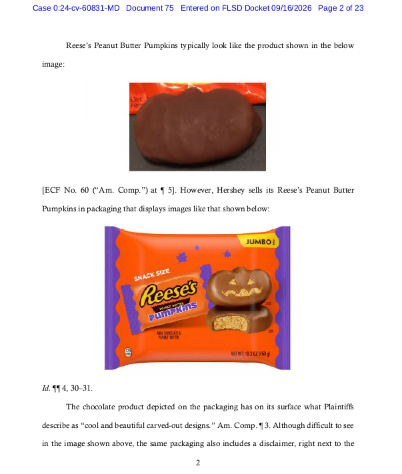
No Concrete Injury in Subjective Disappointment
The plaintiffs alleged that they purchased the seasonal candy because of the “cool and beautiful carved-out designs” depicted on its packaging. They did not allege that the Reese’s products were defective, inedible, or worthless. The court characterized the alleged harm as “subjective disappointment.” That disappointment, by itself, was not a concrete injury sufficient to establish Article III standing.
The Price Premium Gap
The plaintiffs also attempted to establish economic injury by alleging that Reese’s seasonal pumpkins cost as much as 25% more than other Reese’s products. But the prices they cited came from Target, Walmart, and Hershey’s online store, not from Publix, where the plaintiffs actually purchased their candy.
The court found those comparisons insufficient to show that the plaintiffs themselves overpaid. The cited prices did not establish what comparable products cost at the retailer where the challenged transactions occurred, much less isolate any portion of the purchase price attributable to the missing decorative designs.
That conclusion reflects a recurring weakness in price-premium class actions. The allegation of a premium must be tied to the plaintiff’s actual transaction. Comparisons involving different retailers, products, package sizes, locations, or time periods may not demonstrate that a particular plaintiff paid more because of the challenged representation.
Eighth Circuit Precedent
Although the Reese’s decision comes from a Florida federal court, the standing requirements it applied are not unique to the Eleventh Circuit. The Eighth Circuit has developed its own body of precedent reinforcing the same principle.
In Wallace v. ConAgra Foods, Inc., 747 F.3d 1025 (8th Cir. 2014), the plaintiffs alleged that they paid a premium for Hebrew National products labeled “100% kosher” even though some products allegedly failed to satisfy kosher requirements. The plaintiffs’ purchase and consumption were not motivated by faith, and they did not allege a religious injury. The Eighth Circuit recognized that an actual overpayment, even one of only a few pennies, can qualify as a concrete economic injury. The named plaintiffs, however, lacked standing because they did not allege that the particular products they purchased were among those that failed to meet the represented standard.
Similarly, in In re Polaris Marketing, Sales Practices, and Products Liability Litigation, 9 F.4th 793 (8th Cir. 2021), purchasers of off-road vehicles alleged that they would not have bought their vehicles, or would have paid significantly less for them, had they known of an asserted heat defect. The plaintiffs at issue did not allege that the defect had manifested in their own vehicles or caused any damage, degradation, additional servicing, or failure to perform. The court held that their “would not have purchased” or “would have paid significantly less” allegations did not establish an injury in fact.
By contrast, the Eighth Circuit has recognized standing when the plaintiff identifies a specific part of the bargain that was purchased but not received. In Carlsen v. GameStop, Inc., 833 F.3d 903 (8th Cir. 2016), a subscriber alleged that part of his subscription payment purchased the protection of his personal information and that the defendant disclosed that information contrary to its privacy policy. Because the plaintiff sought the difference between the value of the services promised and those actually received, the court found a sufficiently concrete economic injury.
Takeaway for Defendants
The Florida court resolved the Reese’s case at the motion-to-dismiss stage rather than deciding whether a reasonable consumer would interpret the packaging as promising that the candies themselves would bear the depicted designs. Although Hershey’s argument that the images were merely a “decorating suggestion,” as stated in a disclaimer on the packaging, could weigh on the merits of a deceptive-practices claim, the court did not need to reach it. Without a concrete injury, the plaintiffs could not proceed in federal court. The dismissal was without prejudice, however, and does not foreclose the plaintiffs from refiling their claims in state court, where Article III standing requirements do not apply.
For defendants facing consumer class actions in the Eighth Circuit and elsewhere, the decision illustrates the importance of testing standing at the outset. The Reese’s plaintiffs have indicated that they intend to appeal. For now, the decision provides a seasonal reminder that disappointment with a product, without a sufficiently pleaded economic loss, does not create a federal case.