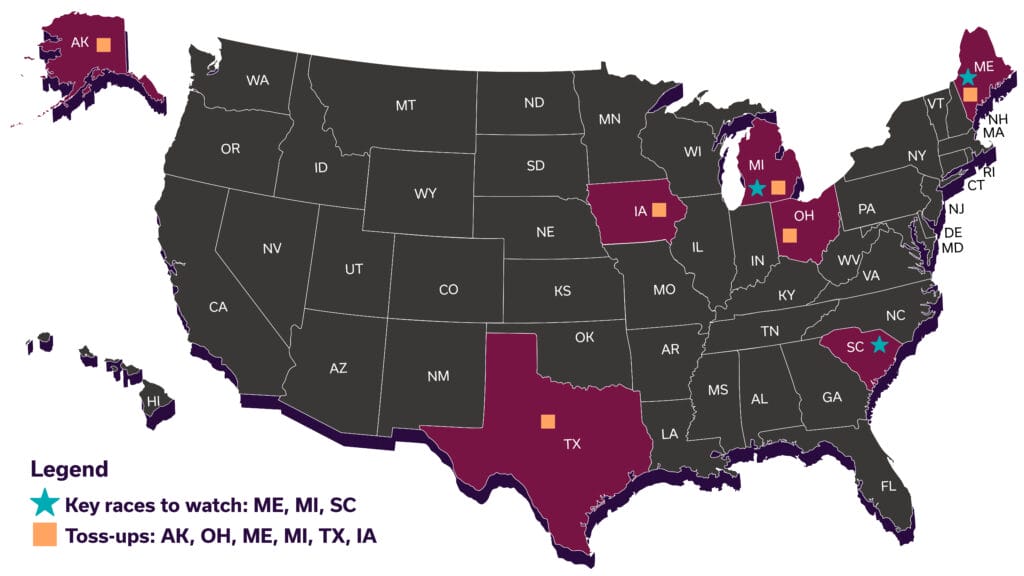
In the span of about two weeks in July 2026, three closely watched Senate contests were upended by a death, a scandal, and a primary dropout, reshaping the political map in Michigan, South Carolina, and Maine. Beyond the recent political upheaval, control of the Senate now likely hinges on four toss-up contests. Heading into the fall, the money race will matter as much as the candidates themselves.
Trump’s approval rating has settled in the low 30s this summer, and history suggests that is a warning sign for his party. Barack Obama was at 47 percent in August 2010, ahead of the midterms where Democrats lost 63 House seats. George W. Bush stood at 36 percent in July 2006, before Republicans lost control of both chambers that November. In Trump’s first term, his approval was 40 percent in August 2018 ahead of a 40-seat Republican loss in the House. His current numbers trail all three. On paper, it seems as if the Democrats have a clear advantage heading into the fall. The month’s events have complicated that picture.
Michigan Democratic Primary
Abdul El-Sayed won Michigan’s Democratic Senate primary on August 4, defeating Representative Haley Stevens in one of the most closely watched primaries of the cycle. El-Sayed overcame a nearly $65 million wave of outside spending backing Stevens, who outspent El-Sayed and his allied groups on advertising by nearly nine to one.
Senators Bernie Sanders (I-VT) and Elizabeth Warren (D-MA) and Representative Alexandria Ocasio-Cortez (D-NY-14) all campaigned for El-Sayed, whose platform centered on Medicare for All, opposition to corporate money in politics, and criticism of Stevens over her support for aid to Israel.
El-Sayed now advances to face former Republican Representative Mike Rogers, who secured the Republican nomination unopposed, in a general election expected to be one of the most competitive in the country and one that could determine which party controls the Senate. Because this seat is currently held by a Democrat, this is a must-win race if Democrats want to have any chance to take back control of the Senate.
South Carolina in the Aftermath of Senator Graham’s Death
Senator Lindsey Graham (R) died July 11 after a brief and sudden illness. South Carolina Governor Henry McMaster appointed Graham’s sister, Darline Graham, to the seat, making her the first woman to represent South Carolina in the U.S. Senate. She was sworn in on July 14 and will serve until January 2027.
Trump said he asked Darline Graham, during an Oval Office visit, to run in the special primary, pledging his endorsement if she entered. She took him up on it, telling Fox News, “I’ve made a decision. I’m in,” after acknowledging the pressure of a fast-approaching filing deadline. The move caught some Republicans off guard, with many in South Carolina assuming she would simply finish out her brother’s term and step aside.
Trump’s endorsement was not enough to clear the field or settle the race outright. Graham and Representative Ralph Norman advanced to an August 25 runoff after neither secured a majority in the crowded August 11 primary. Norman, who placed third in the state’s June gubernatorial primary, campaigned as a fiscal conservative. The runoff winner will face Democratic nominee Dr. Annie Andrews, a Charleston pediatrician, in November.
Maine’s General Election Showdown
Graham Platner submitted formal withdrawal paperwork on July 10, ending his campaign two days after he said he would quit while facing a sexual assault allegation he denied.
Maine law allowed Democrats to name a replacement before the general election, and former Maine Senate President Troy Jackson emerged as the replacement after building a decisive advantage in county-level caucuses. Of the 601 delegates who gathered to formalize the pick, 481 were committed to him. Jackson was formally selected as the party’s Senate nominee on July 25.
Maine is the marquee race of the midterms. Jackson will confront the challenges of his campaign trailing Susan Collins by $11 million with less than 100 days until the election. Democrats had marked Maine as one of their best pickup opportunities of the cycle, and they will most likely need to unseat Collins to have any hope of taking back the Senate. Platner’s exit and the compressed, delegate-driven process that replaced him leaves the party defending that opportunity with a nominee who is still introducing himself to voters and playing catch-up financially at the same time.
The Toss Up Races
Forecasters currently rate four Senate races as genuine toss-ups: Alaska, Ohio, Maine, and Michigan. Democratic candidates may have also put Texas and Iowa into play, according to The Cook Political Report. Alaska has moved into toss-up territory amid Trump’s declining popularity on economic issues and former Representative Mary Peltola’s track record of winning competitive races. Peltola raised more than $9 million in the first quarter alone.
Ohio is technically a special election to fill the remainder of Vice President JD Vance’s Senate term. Republican Jon Husted, appointed to the seat after Vance took office in 2025, is defending it for the first time. Recent polling shows Democrat Sherrod Brown leading Husted 53 percent to 45 percent, an 8-point margin, as Trump’s favorability in the state has fallen. Brown’s campaign seems to have found an issue that is resonating with voters: data centers. Other Democrats are now paying attention to this race as they seek to find a message with broad, bipartisan appeal that is not solely anti-Trump.
In Maine, a new University of New Hampshire poll found Jackson leading Collins 49 percent to 46 percent in a hypothetical general-election matchup, with 2 percent picking someone else and 3 percent undecided.
In Michigan, a mid-August Susquehanna Polling & Research survey found El-Sayed leading Rogers 46 percent to 39 percent, with 9 percent undecided, which is an encouraging sign for El-Sayed as he works to consolidate Democrats who backed Stevens in the primary. Other recent polls have shown a far tighter race, with El-Sayed leading by just a point, underscoring how competitive the seat remains heading into November.
National Fundraising
While the President’s approval rating will undoubtedly have a drag on many Republican candidates in November, the GOP has an enormous cash advantage over Democrats. The three main GOP party committees and their caucus-aligned Super PACs held a $724 million cash-on-hand advantage over Democratic committees at the end of June.
The national picture looks very different at the candidate level. Democratic Senate candidates in several battleground states significantly outraised their Republican rivals. Georgia’s Jon Ossoff (D) banked nearly $43 million cash on hand to GOP Representative Mike Collins’ (GA-10) $2.1 million. North Carolina’s Governor Roy Cooper (D) had almost $21 million on hand to Michael Whatley’s (R) $3.5 million. On paper, both Georgia and North Carolina should be difficult races for Democrats, but Ossoff and Cooper appear to be on solid ground entering the final stretch of the campaign.
Individually, Democratic candidates won the money race. Collectively, their party did not.
What to Watch
A death, a scandal, and a withdrawal have caused key seats to be in flux. Each has drawn immediate, high-profile national intervention, from Trump’s personal endorsement in South Carolina to Warren’s in Michigan. While Democratic candidates find themselves outraising their Republican counterparts, Republican committees and PACs still hold a firm advantage.
These factors make the battle for the Senate this fall as unpredictable as it has been in years. Add to that an unpopular war, concerning economic indicators, and an unpopular president, and control of the chamber may come down to whether Democratic candidates can keep outrunning their own party’s financial disadvantage in enough races.