
Have you ever driven down the road and seen a mountain of smoke rising from a nearby field?
Unless you were in the middle of a raging forest fire, what you likely saw was a prescribed burn. A landowner intentionally setting a fire to help with land management.
Burning is an extremely useful tool for controlling invasive plant species, removing fuels like leaves and dead grasses while recycling their nutrients back into the soil, and promoting new growth that helps provide additional forage for wild animals. All huge benefits.
What Are the Legal Risks?
States have adopted one of three liability standards for damage resulting from fires that escape the prescribed burn area and/or for smoke resulting from the burn: strict liability, gross negligence, and negligence. Dolan v. FEMA, 794 F.Supp.3d, 951, 1040 n. 28 (D. NM 2025).
When I oversaw a prescribed burn on my farm in Missouri, I was held to a negligence standard. VAMS §537.354 (2021). Under that standard, landowners, their agents, and prescribed burn managers are not liable for “damage, injury, or loss caused by a prescribed burning” or from the resulting smoke, unless they are proven to be negligent. Id.
While there hasn’t been a reported decision under the Missouri statute, when I became prescribed burn certified, we were taught by the Missouri Department of Conservation to write and follow an effective burn plan to reduce or eliminate the possibility of being negligent.
Why Take the Liability Risk?
Short answer: burning is that much better than the next best alternative.
Think about a farmer who in late June or early July has a field of shin high winter wheat stubble from their recently harvested crop. That farmer is ready to quickly plant soybeans in that same field to have any shot at a profitable second-crop yield.
The only other potentially reasonable alternative to burning is to till or mechanically work the ground to destroy the wheat stubble. But compared to burning, tilling takes much longer, isn’t as good for soil health, and greatly reduces the soil moisture content which is imperative to having a profitable late season soybean crop.
Tilling isn’t even an option when managing woods. Having a huge fuel load of downed trees as well as years and years of leaves causes wildfire risks. Alternatively, managing that fuel load reduces the risk of wildfire … or that if wildfire reaches that previously-burned area that it will slow down or weaken such that it is more controllable.
How about trying to control invasive species like bush honeysuckle? A burn does that. Or, alternatively, the Missouri Department of Conservation suggests hand-pulling seedlings or cutting each bush stem and immediately applying a herbicide to the stem. We burned about 35 acres of fields and woods on my farm this year. Anyone up for hand-pulling 35 acres of weeds?
Admittedly, a burn isn’t the answer for all common invasive species like autumn olive, but where a burn is an alternative, it commonly is the best alternative. The benefits are significant-so much so that it’s worth the liability risk compared to the next-best alternative for meeting the land-management goals.
Importance of a Burn Plan
While that smoke mountain visible from the road may appear out of control, if things go according to plan, the fire is anything but.
That plan is called a burn plan. It is a specific prescription as to when and how to conduct the burn on a specific parcel of land. The burn plan covers things like:
- Goals and timing of the burn
- Acceptable wind directions
- Wind speed minimums and maximums
- Humidity minimums and maximums
- Mixing height
- Ventilation rate
- Smoke management
- Ignition plan and lighting sequence
- Fire breaks – primary and secondary in the event the primary boundary fails
- Equipment needed
- Number of people needed
In many instances, like with my farm, residents can become prescribed burn certified. When that happens, the Missouri Department of Conservation will either write a burn plan for a property or will assist a certified individual in writing their own burn plan for their property.
The burn plan isn’t just written and filed in a drawer. Instead, there is a pre-burn meeting conducted by the burn manager where the details of the plan are discussed and every person involved is given a copy of the burn and ignition plan.
My Burn
In early January, friends and family gathered to conduct a prescribed burn on my Missouri farm. It started slow. The humidity was on the high side of the burn plan prescription.
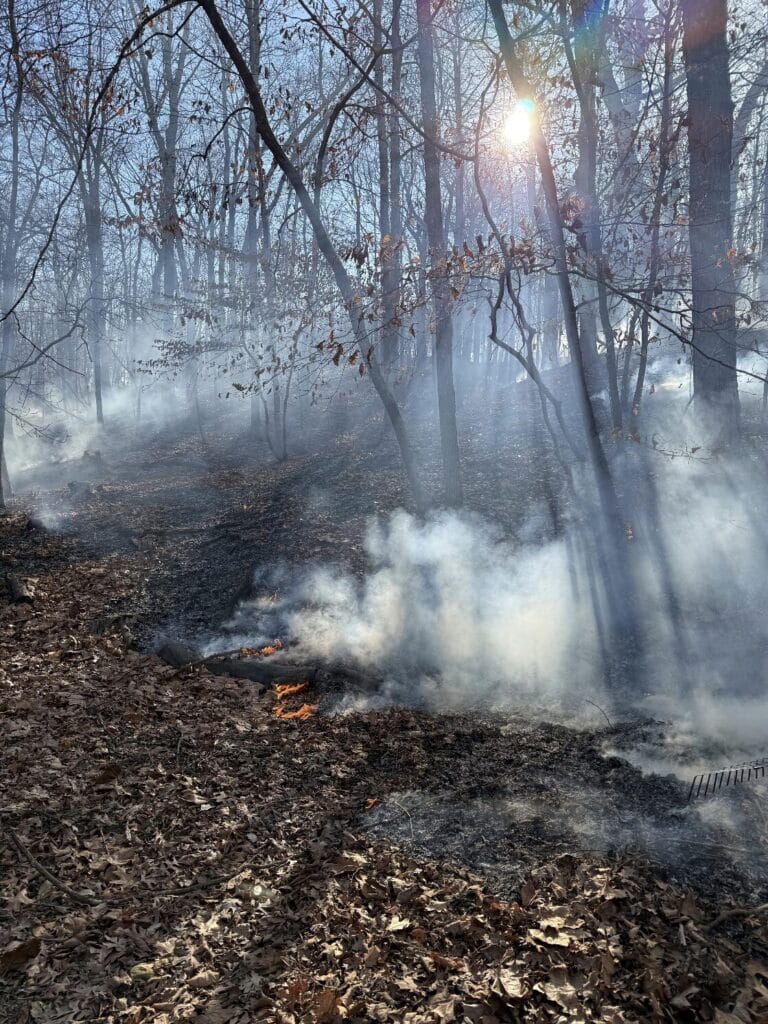
By noon, the temperature rose and the humidity dropped to more ideal conditions.
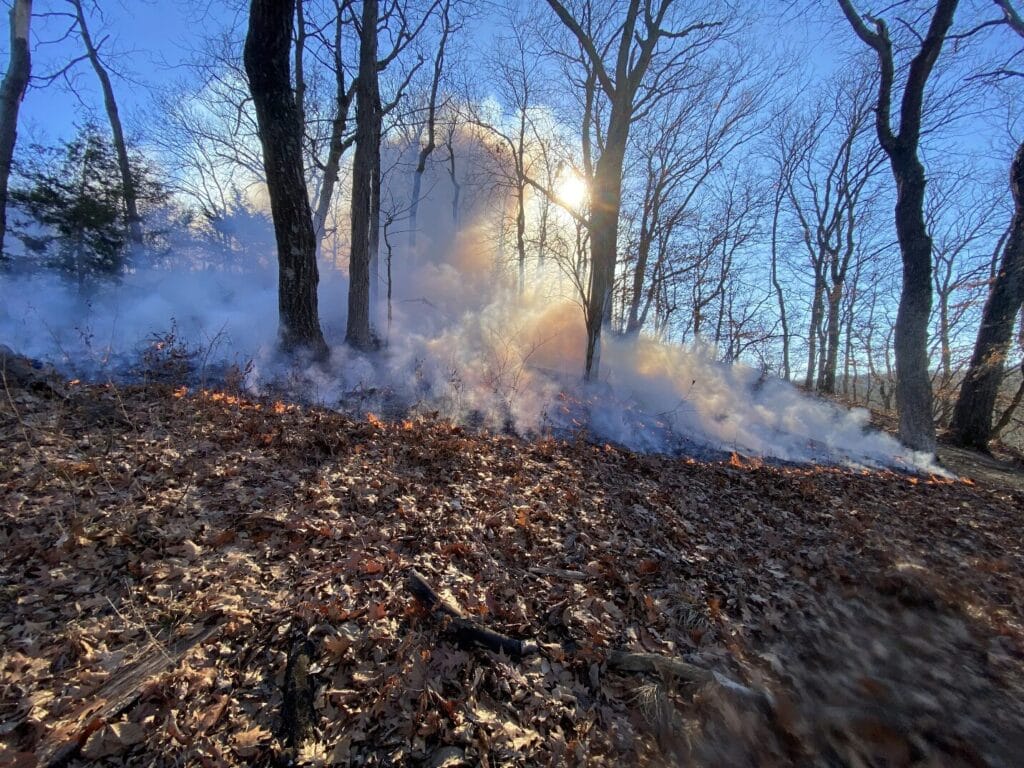
Notice how we lit the downwind side of my burn unit. That is, the leading edge of the fire is fighting against the wind and the smoke is blowing away from the leading fire edge. That was part of the burn and ignition plan to reduce the likelihood that the fire would escape the burn unit. The result when a fire is lit in this manner is that it travels much slower and with much more control than if the upwind side was lit. Had we lit the upwind side at the outset, the resulting fire would have been very fast and potentially out of control as it approached our fire breaks, increasing the likelihood that the fire would escape the prescribed burn area.
Once sufficient area is burned on the downwind side, my ignition plan called for lighting the upwind side of the burn unit. Things really took off.
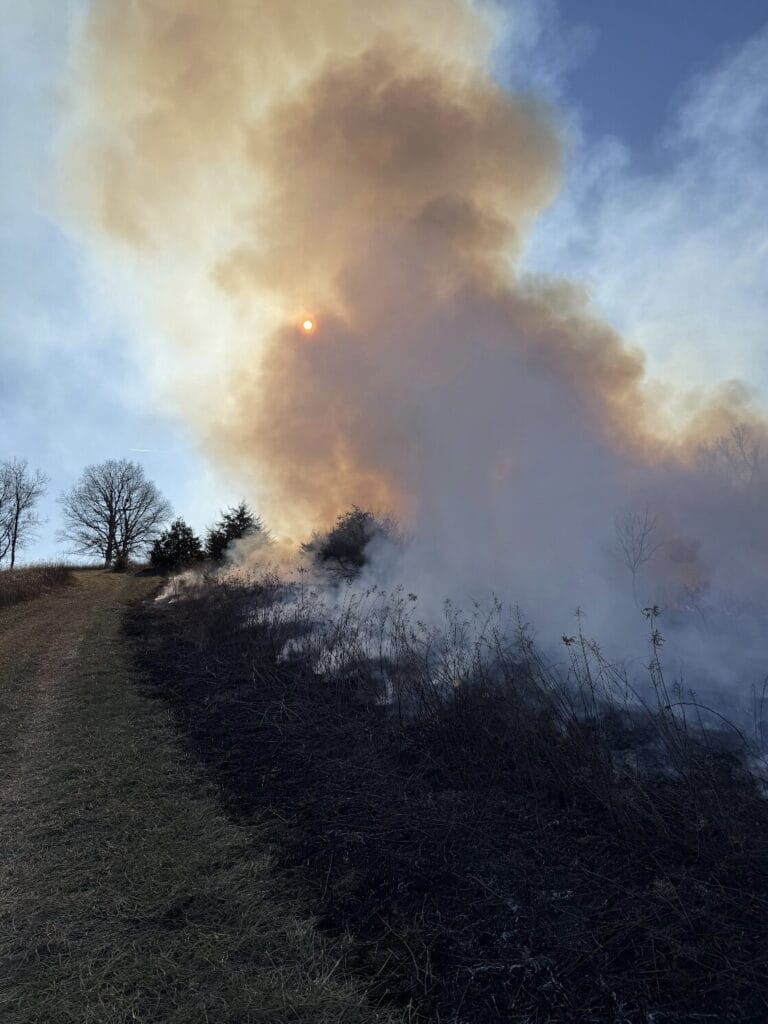
As things took off … they really took off.
All in all, it was a fun, satisfying, and exhausting day. Stress levels were low because we had a professionally written burn plan that we followed to minimize risk and potential liability.
Hopefully the wildlife enjoy the new growth this spring and for years to come.